
Installment Phone Lock: A Security Guide for Mobile Shops
An installment phone lock is the first thing most mobile shops ask about when they start selling phones on qist. It lets the business that sold the phone restrict it if payments stop, and release it when the last payment is made. But a lock on its own does not protect your shop. You also need a clear written agreement, good records, a calm process for late payers, and a plan to stop your phones being cracked.
This guide is for shop owners in Pakistan who sell phones on installments, or plan to. It covers device locks such as Samsung Knox Guard, what to put in the contract, how to keep records, what to do when a customer stops paying, and why cracked lock tools put your business at risk. It is general information, not legal advice. For your own contract, speak to a lawyer.
Why installment phones need a security plan
When you sell a phone on qist, the customer walks out with the full phone after paying only part of the price. The rest is a promise. Most customers keep it. A few do not.
The risks are simple:
- The customer stops paying and stops answering calls
- The phone is sold on to someone else before it is paid off
- The customer gave a false name, address or CNIC
- The lock on the phone is removed with a cracked tool
- There is no signed paper, so it is your word against theirs
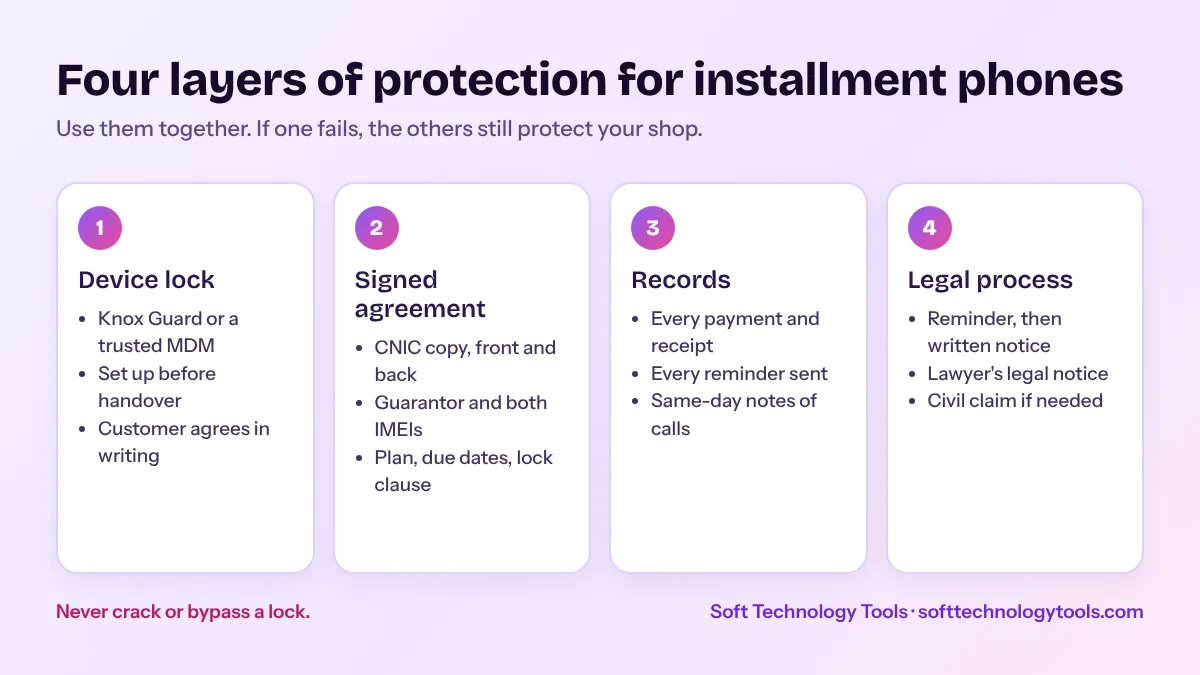
A good plan uses several defences together, so that if one fails, the others still protect you.
How an installment phone lock works
An installment phone lock, sometimes called an EMI lock, is software that lets the seller or finance company control a phone remotely. If a payment is missed, the business can show a reminder on the screen, limit what the phone can do, or lock it fully. When the customer pays, the business releases it.
Samsung Knox Guard
For Samsung phones, the best-known option is Samsung Knox Guard. Samsung describes it as a service for businesses that sell devices on financing plans, such as resellers and retail channels. According to Samsung, it can:
- Lock the phone fully, or limit it to certain functions, even when the phone is offline
- Show custom messages, such as payment reminders, on the screen
- Block changes such as unauthorised firmware flashing
- Release the phone when the plan is complete
Knox Guard needs a licence, and Samsung notes that end-user consent may be required depending on the business model. Availability for your shop in Pakistan should be confirmed with Samsung or an authorised Knox partner before you plan around it.
Other lock apps and MDM
Many shops use third-party lock apps or a mobile device management (MDM) service that works across brands. These vary a lot. Some are run by established companies with support and proper contracts. Others are unknown apps with no clear owner. Before you trust one with your stock, ask:
- Who runs it, and is there a written agreement and support contact?
- Which brands and Android versions does it support?
- What happens to your phones if the app company shuts down?
What a lock can and cannot do
A lock gives the customer a strong reason to keep paying. It does not get your money back or prove the customer agreed to anything. That is the job of the contract and your records.
Lock options compared
| Option | Best for | Main strength | Main weakness |
|---|---|---|---|
| Samsung Knox Guard | Shops selling Samsung phones through an approved setup | Lock is built into the device and is hard to tamper with | Samsung only; licence and approval needed |
| Third-party lock app or MDM | Shops selling several brands | One dashboard for many phones | Quality and support vary; some are easier to tamper with |
| Contract and records only | Trusted repeat customers, small amounts | No extra cost or setup | Nothing stops the phone being used or sold if payments stop |
Most shops use a lock on every financed phone, plus a contract and records for every sale.
The installment agreement: what to put in writing
The written agreement is your main protection if a case ever goes to a lawyer, the police or a court. Keep it short, clear and in a language the customer understands. Read it to them if needed. Ask a lawyer to check your template once, then use it for every sale.
- Customer identity. Full name, father’s or husband’s name, address, mobile number and CNIC number. Keep a clear copy of the original CNIC, front and back, and check the photo against the person in front of you.
- A guarantor. Many shops ask for a guarantor with their own CNIC copy and signature. Their details belong in the agreement too.
- The phone. Brand, model, colour and both IMEI numbers. Check the IMEIs on the box match the phone by dialling *#06#.
- The money. Total price, advance paid, number of installments, amount and due date of each, and how payments are made.
- The lock. A plain statement that the phone has a payment lock, that it may be limited or locked if a payment is missed, and that it will be released once paid in full. The customer should sign that they understand this.
- What happens on default. Late reminders, how many missed payments lead to a lock, and that you may take legal action to recover the balance.
- Signatures and date. Customer, guarantor and your shop, with a thumb impression if that is your practice. Give the customer a copy.
If you take post-dated cheques, record each cheque number in the agreement.
Record keeping that holds up later
Good records turn a dispute into a simple timeline. For every sale, keep:
- The signed agreement and the CNIC copies, stored safely and not shared
- A photo of the phone’s box and IMEI label
- Every payment with date, amount and method, plus a receipt to the customer
- Every reminder you sent, with date and how it was sent
- Notes of calls and visits, written on the same day
Keep paper copies in a locked file and digital copies in a system with a backup. Customer CNICs are personal data, so only the people who need them should see them.
When a customer stops paying
A missed payment is not a crime. Most late payers have a cash problem. A calm, written process gets more money back and keeps you within the law.
- Friendly reminder. A message or call a day or two after the due date.
- On-screen reminder. If your lock supports it, show a payment reminder before you restrict the phone.
- Written notice. A short notice with the amount due and a final date to pay. Keep a copy.
- Contact the guarantor. Politely, and only as your agreement allows.
- Restrict or lock the phone as set out in the agreement the customer signed.
- Legal notice through a lawyer. This often settles the matter.
- Legal action. Your lawyer can advise on a civil claim to recover the balance. If a cheque the customer gave you bounces, dishonestly issuing a cheque that is dishonoured is an offence under section 489-F of the Pakistan Penal Code. Laws are published on the official Pakistan Code website.
What you must never do:
- Take the phone back by force or threaten the customer or their family
- Post the customer’s name, photo or CNIC online or in groups
- File a false stolen report. Theft reports, including the PTA stolen phone process, are only for phones that are really lost or stolen
Why cracked lock tools are illegal and risky
Some people offer to remove installment locks, Knox Guard or other MDM locks for a fee, using cracked tools. For a shop, getting involved in this is a serious mistake, whichever side you are on.
- It is likely a crime. Pakistan’s Prevention of Electronic Crimes Act, 2016 makes unauthorised access to, and interference with, information systems and data an offence. Removing a lock that belongs to someone else’s business is exactly that kind of interference.
- The phone is not yours. A phone that is still being paid for is owned or secured by the business that financed it. Unlocking it to sell it on can lead to fraud complaints.
- Cracked tools carry malware. Cracked software often hides viruses that steal accounts and payment details from the shop’s own computers.
- It ruins your name with suppliers, finance partners and customers.
At STT we do not remove, bypass or crack installment locks, Knox, MDM, FRP or iCloud locks for anyone. FRP and account work for genuine owners is done only with proof of ownership, as our FRP proof of ownership guide and device policy explain. A finance lock should only ever be released by the business that set it.
How to stop your phones being cracked
You cannot make any phone impossible to tamper with, but you can make your phones a poor target.
- Use an official, device-level lock where you can. Locks built into the phone’s security, like Knox Guard on Samsung, are much harder to tamper with than a simple app.
- Enrol before handover. Never hand over a financed phone and promise to add the lock later.
- Turn on flashing and reset protection if your lock service offers it.
- Keep phones updated. Install official software updates before the sale.
- Check status regularly. A phone that stops reporting to your dashboard is a warning sign. Call the customer the same week.
- Record the IMEIs. If a phone is truly stolen, the owner can report it. Shops can check a phone with the free IMEI check in the STT theft registry.
How STT can help your shop
Partner shops can use the STT Shopkeeper Portal to send repair jobs and keep customer and credit records. If you want automatic payment reminders and a proper customer record for your installment business, our team can set up a CRM for you. Contact us and we reply within one working day.
Frequently asked questions
Is it legal to lock a phone sold on installments?
A payment lock that the customer knew about and agreed to in writing is widely used by sellers and finance companies. Put the lock clearly in your agreement and have the customer sign it. For your exact contract wording, ask a lawyer.
What is Samsung Knox Guard?
Knox Guard is a Samsung service that lets businesses that sell devices on financing plans lock, limit and release Samsung phones remotely. It needs a licence, and you should confirm with Samsung or an authorised partner whether it is available for your shop.
Can a customer remove an installment lock themselves?
A properly set up lock is built to resist this. Removing someone else’s lock without permission may be an offence under Pakistan’s cybercrime law. The right way is to pay off the balance so the seller releases the phone.
What documents should I take from a qist customer?
A copy of the original CNIC (front and back), a signed agreement with the phone’s IMEIs and the payment plan, and, if you use one, a guarantor’s CNIC copy and signature. Give the customer a copy of the agreement.
Can I report a phone as stolen if the customer stops paying?
No. Theft reports are for phones that are really lost or stolen. A false report can lead to action against you. Unpaid installments are a matter for your agreement, your lock and, if needed, a lawyer.
Does STT unlock installment or Knox locked phones?
No. We never remove, bypass or crack installment, Knox, MDM, FRP or iCloud locks. A finance lock can only be released by the business that set it.
خلاصہ (اردو)
- قسطوں پر بیچے گئے فون کے لیے صرف لاک کافی نہیں: لاک، لکھا ہوا معاہدہ، مکمل ریکارڈ اور قانونی طریقہ، چاروں ساتھ استعمال کریں۔
- سام سنگ فون کے لیے Knox Guard جیسا آفیشل لاک بہتر ہے؛ پاکستان میں دستیابی سام سنگ یا مجاز پارٹنر سے معلوم کریں۔
- معاہدے میں گاہک کا شناختی کارڈ (آگے اور پیچھے)، دستخط، ضامن، فون کے دونوں IMEI، قسطوں کی تفصیل اور لاک کی شرط لکھیں۔
- قسط رک جائے تو پہلے یاد دہانی، پھر تحریری نوٹس، پھر وکیل کے ذریعے قانونی نوٹس۔ زبردستی فون نہ چھینیں اور جھوٹی چوری رپورٹ نہ کریں۔
- کریک ٹول سے لاک ہٹانا غیر قانونی اور خطرناک ہے۔ STT کسی بھی قسط، Knox، MDM، FRP یا iCloud لاک کو نہیں توڑتا۔
Khulasa (Roman Urdu)
- Qist par phone bechne ke liye sirf lock kaafi nahin: lock, likha hua muahida, record aur qanooni tareeqa, sab saath rakhein.
- Muahide mein CNIC copy, dastakhat, zamin, dono IMEI aur qiston ki tafseel likhein.
- Qist ruk jaye to reminder, phir written notice, phir wakeel ke zariye legal notice. Zabardasti ya jhooti chori report na karein.
- Crack tool se lock hatana ghair qanooni hai. STT koi lock nahin todta.
Related guides
POS Software in Pakistan: Ready-Made or Custom?
POS software in Pakistan: a feature checklist, ready-made vs custom compared, and what FBR POS integration means for Tier-1 retailers…
Ghost Touch Problem Solution for Android and iPhone
Ghost touch problem solution for Android and iPhone: check the protector, charger, moisture and touch settings, test the screen, or get it…
WordPress Website for Business in Pakistan: Pros and Cons
WordPress website development services in Pakistan: honest pros and cons, hosting requirements, security and updates, and when Shopify or…