
Shopify in Pakistan: How to Start an Online Store (2026 Guide)
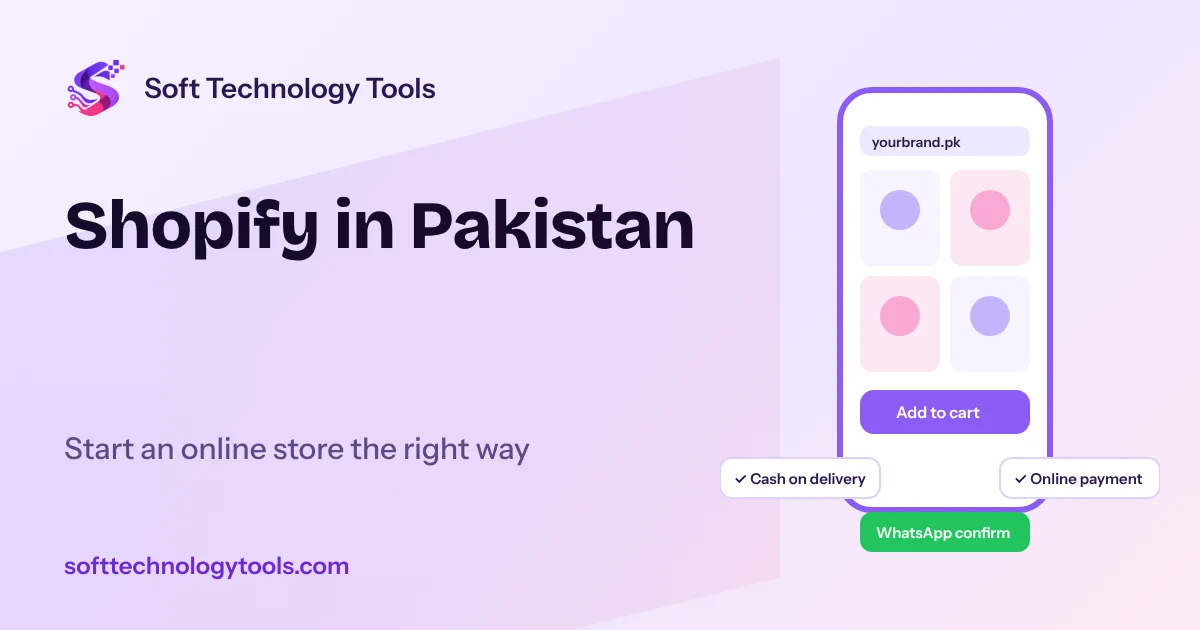
Shopify in Pakistan is one of the most searched questions from shop owners who want to sell online. You have a product, maybe a few hundred followers on Instagram or Facebook, and orders coming in by WhatsApp. Now you want a proper store with a checkout, stock levels and order tracking. Shopify is a strong option, but it works a little differently in Pakistan than in the UK or the USA, and a few early choices make a big difference later.
This guide explains how Shopify works for a business in Pakistan, how payments and cash on delivery fit in, what you need before you start, and when a different platform makes more sense. It is written for owners, not developers, so you can make the decision with your eyes open.
What Shopify is, in plain words
Shopify is an online store builder that you rent by the month. It gives you the shop front (product pages, a cart and a checkout), the back office (orders, customers, stock) and the hosting, all in one account. You do not need to buy a server or install software. You choose a theme, add your products, connect a domain name and start taking orders.
The trade-off is that you work inside Shopify’s system. You can add features with apps, and a developer can customise the theme, but some things are done the Shopify way. For most small and medium stores that is a good thing: fewer moving parts, fewer things to break.
Does Shopify work in Pakistan?
Yes. A business in Pakistan can open a Shopify store, list products in Pakistani rupees, ship within Pakistan and sell abroad. Many local brands in clothing, cosmetics, accessories and home goods run on it.
The main difference is payments. Shopify’s own payment system, Shopify Payments, is only available in certain countries, and Pakistan is not on Shopify’s list of supported countries. That does not stop you from selling. It means you take payments in other ways, which the next section covers.
Payments and cash on delivery
In Pakistan, many customers still prefer to pay when the parcel arrives. A store that does not offer cash on delivery (COD) usually loses a large share of orders, especially outside the big cities. Shopify lets you add cash on delivery as a manual payment method, so the customer places the order without paying online and pays the courier at the door.
For online payments by card or wallet, Pakistani stores use a payment gateway that connects to Shopify. Before you choose one, ask the gateway three things:
- Does it work with Shopify today? Ask for the exact app or integration and test it on a real order.
- What are the fees and when is money settled? Get this in writing, including any setup charge.
- Which methods does it support? Cards, bank transfer and mobile wallets each matter to different customers.
A practical setup for many new stores is cash on delivery first, then an online gateway once orders are steady. To cut fake COD orders, confirm each order on WhatsApp before you ship. This one step saves a lot of wasted courier charges, and it can be automated with a WhatsApp bot that asks the customer to confirm.
What Shopify costs
Shopify charges a monthly plan fee, and plans and prices change from time to time, so always check the current numbers on Shopify’s pricing page before you decide. On top of the plan, budget for:
- A domain name (for example yourbrand.com or yourbrand.pk). A .pk domain is registered through PKNIC or a reseller.
- A theme. Shopify has free themes; paid themes are a one-time cost.
- Apps for things like reviews, WhatsApp chat buttons or courier booking. Many charge monthly, so add only what you use.
- Payment and courier fees per order.
- Setup and design if you hire someone to build the store.
For a full picture of what a website or online store costs to build in Pakistan, see our guide to website cost in Pakistan. At STT, every project gets a fixed written quote after a free call, with no hidden extras.
How to start, step by step
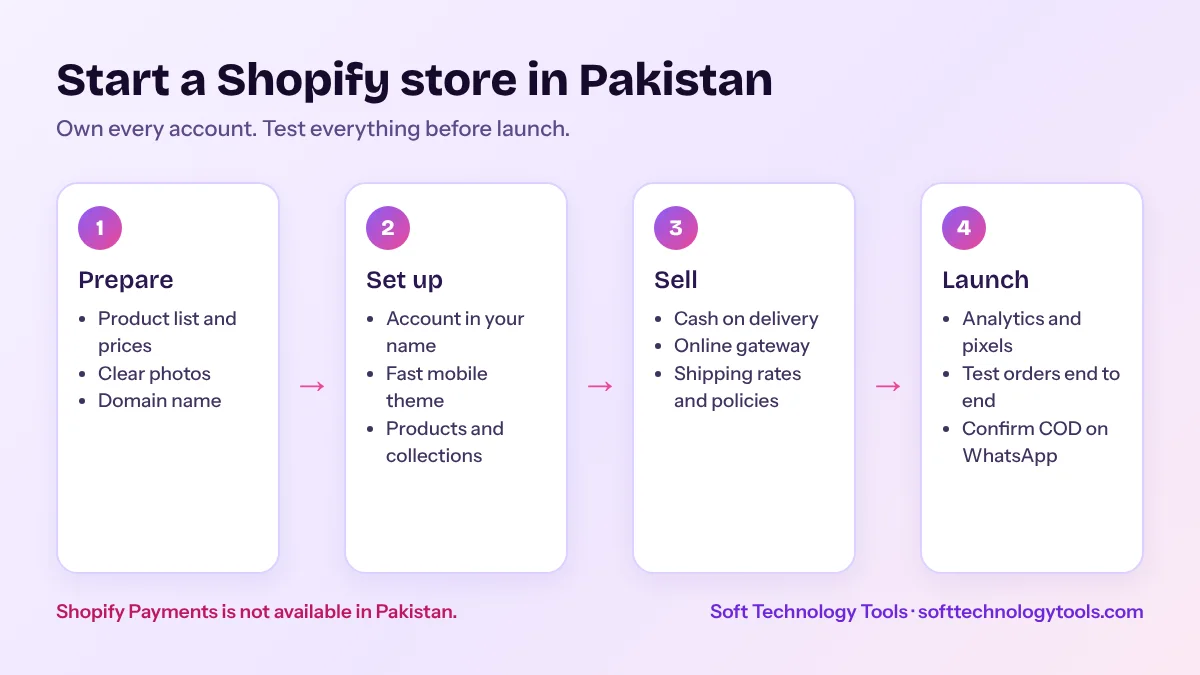
- Get your product list ready. Names, prices, sizes or colours, stock counts and clear photos on a plain background. This is the work that takes longest, so start here.
- Choose your domain name. Short, easy to spell, and the same as your social media handle if you can.
- Open the Shopify account in the business’s name and email, not a freelancer’s. You should own the store and every login.
- Pick a theme that is fast on mobile. Most of your customers will shop on a phone over mobile data, so test the theme on a real phone, not just a laptop.
- Add products and collections. Group products the way customers think, for example “Lawn suits”, “New arrivals” or “Gifts”, so they can find things fast.
- Set up shipping zones and rates for your cities, and decide whether delivery is free above a certain order value.
- Add payment methods: cash on delivery, and an online gateway if you have one.
- Write your policies: delivery times, returns, exchanges and refunds. Clear policies reduce WhatsApp questions and build trust.
- Connect analytics and your ad pixels so you can see which ads bring real orders.
- Place test orders from start to finish, including a cancelled order and a return, before you announce the launch.
Shopify, WooCommerce or a marketplace?
Shopify is not the only route. Here is how the main options compare for a Pakistani business:
| Option | Best for | Watch out for |
|---|---|---|
| Shopify | Brands that want their own store with little technical upkeep | Monthly plan and app fees; Shopify Payments not available in Pakistan |
| WooCommerce (WordPress) | Stores that want full control and custom features | You need hosting, updates, backups and security care |
| Marketplaces (for example Daraz) | Reaching buyers who already shop there | Commission per sale, marketplace rules, and you do not own the customer |
| Custom-built store | Unusual pricing, B2B ordering or deep integrations | Higher build cost and longer timeline |
Many businesses use more than one: their own Shopify store for repeat customers and brand building, and a marketplace for extra reach. If you are unsure, our website development team can talk it through with you on a free call.
Mistakes that cost sales
- Slow pages on mobile. Too many apps and huge images make the store slow on 4G. Every extra second loses customers.
- No cash on delivery. For most Pakistani stores this is a must at the start.
- Unclear delivery and return rules. Customers will not order if they are unsure what happens next.
- No order confirmation. Shipping unconfirmed COD orders leads to returns and lost courier fees.
- Accounts in someone else’s name. Always keep the Shopify, domain and payment accounts under the business’s own email.
- No follow-up. Abandoned carts and enquiries that nobody answers are lost sales. A simple follow-up system brings many of them back.
Frequently asked questions
Can I use Shopify in Pakistan?
Yes. You can open a store, sell in Pakistani rupees and ship anywhere you choose. The difference is that Shopify Payments is not available in Pakistan, so you use cash on delivery and a third-party payment gateway instead.
Does Shopify support cash on delivery in Pakistan?
Yes. You can add cash on delivery as a manual payment method. Confirming each COD order on WhatsApp before shipping helps cut fake orders and returns.
How much does Shopify cost per month?
Shopify’s plan prices change, so check Shopify’s pricing page for current numbers. Add the cost of your domain, any paid theme, apps, and payment and courier fees per order.
Is Shopify better than WooCommerce?
It depends on what you need. Shopify is easier to run and needs less technical care. WooCommerce gives more control but needs hosting, updates and backups. Both can work well for a Pakistani store.
Can you build my Shopify store?
Yes. Soft Technology Tools builds Shopify stores and custom online stores for businesses in Pakistan and abroad, from our offices in Lahore and Karachi. You get a fixed written quote after a free call, and you own every account and login. Get a quote or message us on WhatsApp.
Related guides
POS Software in Pakistan: Ready-Made or Custom?
POS software in Pakistan: a feature checklist, ready-made vs custom compared, and what FBR POS integration means for Tier-1 retailers…

Ghost Touch Problem Solution for Android and iPhone
Ghost touch problem solution for Android and iPhone: check the protector, charger, moisture and touch settings, test the screen, or get it…
WordPress Website for Business in Pakistan: Pros and Cons
WordPress website development services in Pakistan: honest pros and cons, hosting requirements, security and updates, and when Shopify or…