
How to Get More Customers for Your Business: Follow Up Every Lead
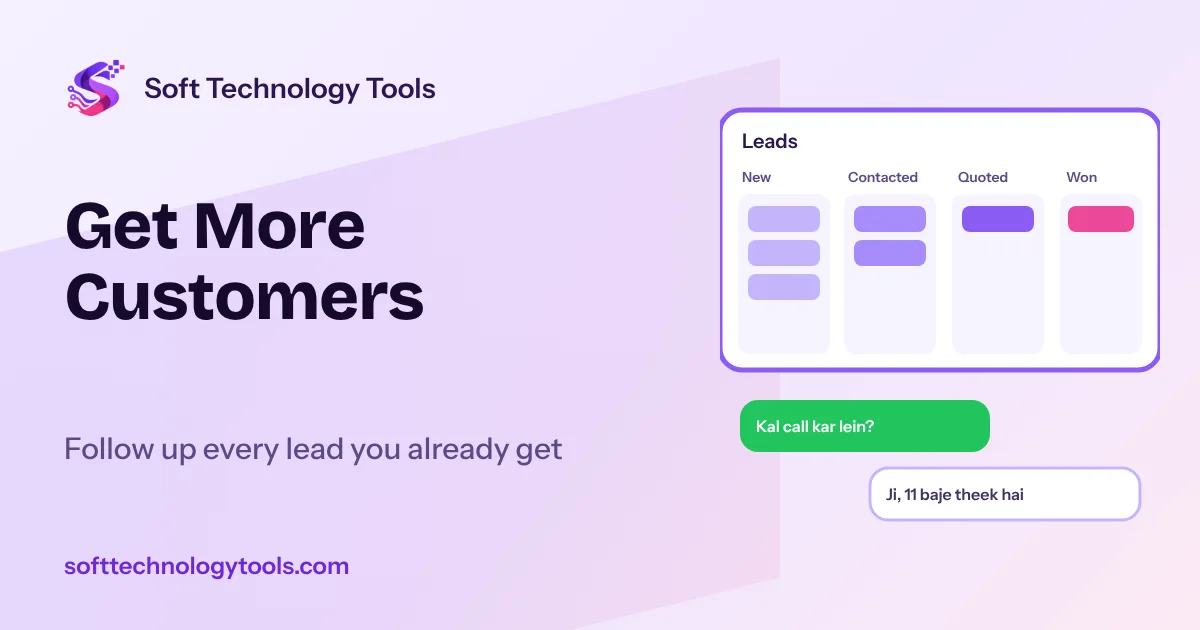
How to get more customers for your business is usually answered with “spend more on ads”. But for most small businesses in Pakistan, the quickest win is not more enquiries. It is answering and following up the enquiries you already get. A message that waits until the evening, a caller who never hears back, a quote that nobody chases: each one is a customer you paid to attract and then let go.
This guide shows a simple follow-up system any small business can run, from a clinic or salon to a showroom, a consultant or an online store. It starts with a notebook-level process and grows into automation when you are ready. No jargon, and no expensive software needed on day one.
Where customers slip away
Before you spend more on marketing, look at what happens to an enquiry after it arrives. Most leaks fall into a few patterns:
- Slow first reply. The customer messaged three businesses and bought from the first one that answered properly.
- No owner. Enquiries arrive on WhatsApp, Instagram, Facebook, the website and phone calls, and nobody is sure who is handling which one.
- No second message. The customer said “let me think”, and nobody asked again.
- Lost history. A staff member leaves, and their chats and notes go with them.
- Quotes that are never chased. A price was sent, the customer went quiet, and the trail went cold.
Fix these and the same marketing budget brings in more paying customers.
Reply fast, every time
Speed matters because people contact more than one business at once, especially for services they need soon. Set a clear standard, for example “every enquiry gets a real reply within business hours the same day”, and make sure someone owns it.
Three things make fast replies easier:
- Saved replies for the questions you answer every day: prices, location, timings, delivery.
- An instant first message outside working hours that says when you will reply and asks the key questions up front.
- A bot for the first steps. A WhatsApp AI bot can answer common questions in Urdu and English, collect the customer’s details and hand over to a person when needed.
Keep every lead in one place
You cannot follow up what you cannot see. Every enquiry, from every channel, should end up in one list with five details:
- Name and contact number
- What they want
- Where they came from (an ad, Google, a referral, walk-in)
- The current stage: new, contacted, quoted, won or lost
- The date of the next follow-up
On day one this can be a shared spreadsheet. As volume grows, a CRM does the same job better: it collects leads from forms and ads automatically, shows the pipeline at a glance and reminds staff when a follow-up is due. Our guide to AI chatbots for lead generation shows how bots and CRMs work together.
A simple follow-up plan
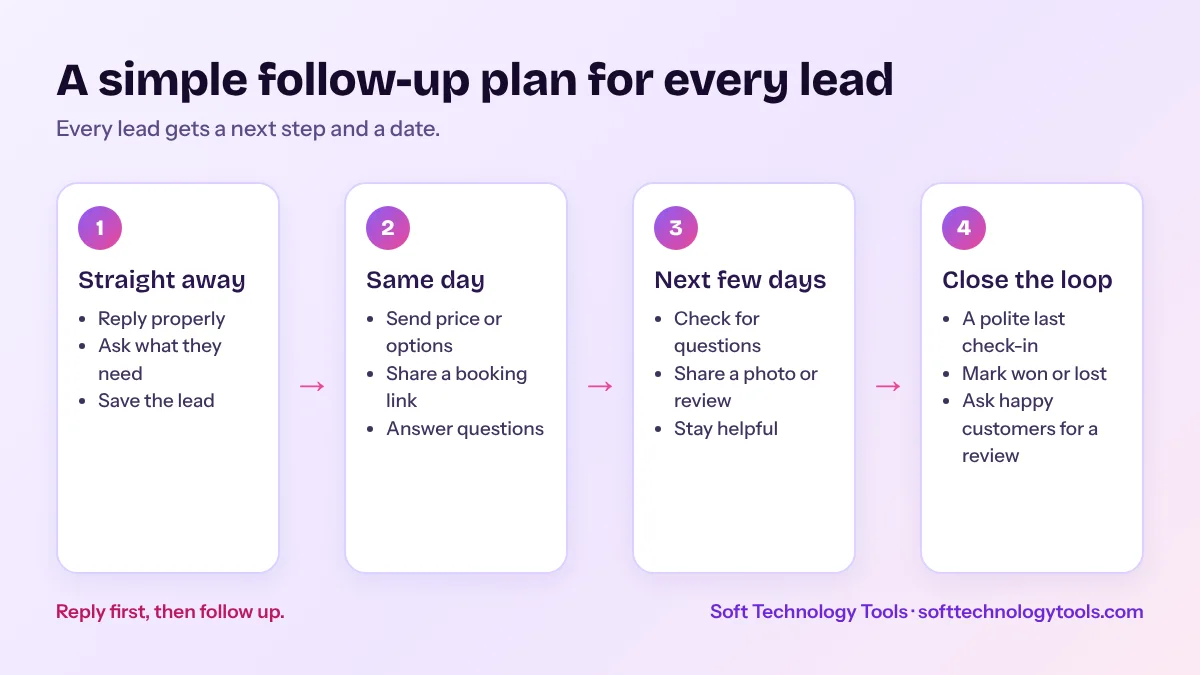
Most customers need more than one message before they decide. A simple plan that many businesses can adapt:
| When | What to do | Goal |
|---|---|---|
| Straight away | Reply and ask one or two questions about what they need | Start a real conversation |
| Same day | Send the price, options or a booking link | Give them what they need to decide |
| Next day | Check whether they have any questions | Remove doubts |
| A few days later | Share something useful: a photo, a review, an answer to a common worry | Build trust |
| A week or two later | A polite last check-in, then mark the lead won or lost | Close the loop |
Adjust the timing to your business. A clinic appointment moves faster than a furniture order. The important part is that every lead has a next step and a date.
What to say in follow-ups
Good follow-ups are short, personal and useful. Avoid “Sir, any update?” on repeat. Try messages like these:
- “Hi Ayesha, you asked about the bridal package for December. Would a quick call tomorrow help you compare the options?”
- “Assalam o Alaikum, the size you asked about is back in stock. Shall I reserve one for you?”
- “Following up on the quote we sent on Monday. Is there anything you would like us to change?”
Keep the customer’s language. Many customers in Pakistan are more comfortable in Urdu or Roman Urdu, and a reply in their style feels more personal.
When to automate
Start manually so you learn what works. Automate when:
- you get more enquiries than your team can answer quickly;
- leads come from several channels and some get lost;
- follow-ups depend on one person remembering; or
- you want reports on which ads and channels bring paying customers, not just clicks.
A typical setup connects your website forms, ads and WhatsApp to a CRM, sends automatic follow-ups by WhatsApp, email or SMS, and alerts staff when a hot lead replies. For calls and reminders, an AI calling agent can confirm appointments and chase missed calls. See our CRM and automation service for what this looks like in practice.
Turn customers into more customers
The follow-up does not end at the sale. Happy customers bring the next ones:
- Ask for a Google review a day or two after a good experience, with a direct link. Reviews help you show up in local search and give new customers confidence.
- Ask for referrals while the customer is pleased, and thank people who refer.
- Stay in touch with useful messages, not constant promotions, so customers think of you next time.
Your Google Business Profile matters here too. Google’s own Business Profile help explains how to keep it complete and how reviews work.
Frequently asked questions
How can I get more customers for my small business?
Start by replying faster and following up every enquiry you already get. Keep all leads in one list with a next step and a date, then add marketing once nothing is slipping through.
How many times should I follow up with a lead?
Several times over one to two weeks usually works, as long as each message is useful and polite. Stop when the customer says no, and mark the lead as lost so your list stays clean.
Do I need a CRM for a small business?
Not on day one. A shared spreadsheet works while volume is low. A CRM helps once leads come from several channels or several people handle them, because it automates reminders and keeps history in one place.
Can follow-ups be automated on WhatsApp?
Yes, through the official WhatsApp Business API with approved message templates sent to customers who opted in. Unofficial bulk tools put your number at risk.
Can you set up a follow-up system for my business?
Yes. Soft Technology Tools sets up CRMs, WhatsApp bots, AI calling agents and automatic follow-ups for businesses in Pakistan, the UAE, the UK and the USA, from our offices in Lahore and Karachi. You get a fixed written quote after a free call. Get a quote or message us on WhatsApp.
Related guides
POS Software in Pakistan: Ready-Made or Custom?
POS software in Pakistan: a feature checklist, ready-made vs custom compared, and what FBR POS integration means for Tier-1 retailers…
Ghost Touch Problem Solution for Android and iPhone
Ghost touch problem solution for Android and iPhone: check the protector, charger, moisture and touch settings, test the screen, or get it…
WordPress Website for Business in Pakistan: Pros and Cons
WordPress website development services in Pakistan: honest pros and cons, hosting requirements, security and updates, and when Shopify or…